




Microcement for commercial spaces: seamless floors and bathrooms in shops, offices and rental properties
What microcement can offer commercial buildings and public spaces: seamless, hard-wearing floors, easy cleaning, thousands of colors, and renovated bathrooms without a complete demolition.

Shops, offices, cafés, rental properties and public restrooms all have one thing in common: their surfaces need to withstand heavy use, be easy to keep clean and look good over time. Microcement creates seamless floors and walls without grout lines, in a thin layer of around 3 mm that can often be applied to existing surfaces. In this article, we look at what microcement can offer architects, contractors and property owners in commercial buildings and public spaces.
Why use microcement in commercial premises?
- Seamless: no grout lines or joints, just one continuous surface throughout the room. This creates a calm look and fewer places for dirt to collect.
- Thin layer: around 3 mm in total. It can often be applied to existing surfaces without demolition and rarely affects skirting boards, frames or doors.
- Durable with the right topcoat: the topcoat determines durability and makes the surface more resistant to spills, stains and wear.
- Easy to clean: a smooth, washable surface without grout lines.
- A consistent look across floors, walls and features: microcement can be used on floors, walls, bathrooms, kitchens, stairs, benches and counters.
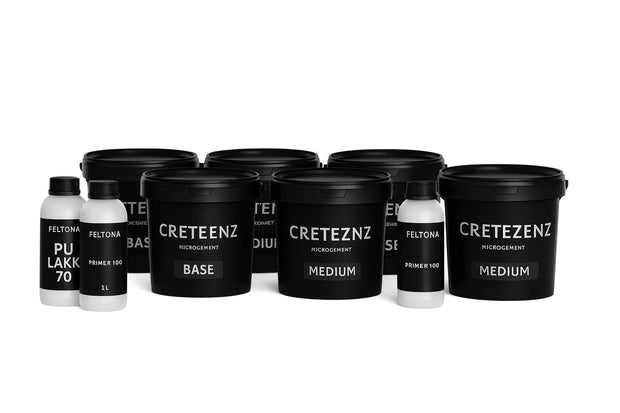
- Feltona microcement: we offer different types of Feltona microcement, suited to floors, walls, wet rooms and other applications.
Shop and office floors that are easy to maintain
We have installed microcement in both shops and offices. In a shop or office, the floor is the first thing customers and employees see, and the surface that gets the most wear. A seamless microcement floor has no grout lines where dirt and water can seep in, and it is easy to clean. With the right topcoat, the floor can withstand daily foot traffic. For heavy use, such as office chairs with wheels, pallet trucks and similar, we can advise on reinforced lacquer and maintenance. Microcement is an alternative to concrete, polished concrete and epoxy flooring for those who want a soft, mineral look in a thin layer.
The substrate must be firm, level and stable, as microcement cannot correct unevenness. Underfloor heating cables and movement joints must be handled correctly. Read more about microcement flooring.


Designer flooring in thousands of colours
For architects and interior designers, the freedom to choose colours is a major advantage. We mix colours to order, including to match NCS codes, and offer more than 3,500 colours to choose from. You can find 17 standard colours in our online store. The texture is selected separately, ranging from smooth and subtle to pronounced trowel marks. Feel free to request colour samples, as the tone and texture look different in different lighting.

Rental properties: renovate the bathroom without a full demolition
For property owners and landlords, the bathroom is often the room that takes the longest and costs the most to renovate. In many cases, microcement can be applied over existing tiles, giving the bathroom a fresh, modern look between tenancies or before a sale, often without a full demolition.
In bathrooms, it must be assessed whether the existing waterproofing membrane is approved and intact. We often recommend applying a new membrane over the tiles before the microcement. Microcement is a surface finish, not a waterproofing system: wet zones such as showers must be built up with an approved membrane system in accordance with current wet-room requirements, by a qualified professional. Read more about microcement in bathrooms.
Public restrooms and communal areas
Zenzorama has installed microcement in public restrooms and offices. In these spaces, as well as in changing rooms and communal areas, cleaning and wear resistance are crucial. Seamless surfaces on floors and walls make them easier to keep clean, and the topcoat makes the surface more resistant to spills and stains. Slip-resistance requirements depend on the room. We select the topcoat and texture to suit the project requirements. In wet zones, the same membrane requirements apply as in other bathrooms.

How microcement is applied
- Preparation: the substrate must be firm, clean, dry and level. In bathrooms, the membrane is assessed.
- Primer: creates adhesion between the substrate and the microcement.
- Two base coats: build strength and evenness.
- Two top coats: provide colour and texture.
- Topcoat: selected according to use and level of wear.
The topcoat should be maintained regularly, depending on wear. We provide a maintenance plan for the project.
Frequently asked questions about microcement in commercial buildings
Is microcement suitable for shop and office floors?
Yes, on a firm and level substrate. With the right topcoat, the floor can withstand daily use, and the seamless surface is easy to keep clean.
Can microcement be applied over an existing floor?
Yes, on a firm and level substrate. The substrate is assessed for each project.
Is microcement waterproof?
No, not on its own. Microcement is a surface finish. In wet zones, waterproofing is provided by an approved membrane system underneath, in accordance with current wet-room requirements and installed by a qualified professional.
Can we renovate bathrooms in rental properties by applying microcement over tiles?
Often yes, but it must be assessed whether the existing membrane is approved and intact. We often recommend applying a new membrane over the tiles before the microcement.
How many colours are available?
We mix colours to order, including to match NCS codes, and offer more than 3,500 colours to choose from. You can find 17 standard colours in our online store.
How durable is microcement?
It depends on the type. Its durability in use also depends on the substrate and topcoat.
Can microcement withstand underfloor heating?
Yes, microcement can be applied to heated floors when mixed with a hardener. The heating must be switched off before and during application, and must be controlled according to the supplier’s instructions.
Is microcement slip-resistant?
Slip resistance depends on the topcoat and texture. We can advise on the right solution for the room and its intended use.
What fire classification does microcement have?
The fire classification depends on the system and substrate. Contact us for product documentation for your project.
How much does microcement cost for commercial premises?
Professionally installed microcement costs from NOK 2,000 to 3,000 per m² for floors and from NOK 2,500 to 3,500 per m² for bathrooms, including materials and VAT. The minimum price for a job is NOK 30,000. Larger areas are priced per project, so tell us about your project.
Do you supply larger projects?
Yes. Contact us for project pricing, and we’ll discuss volume and schedule.
Proff eller større prosjekt?
Vi leverer materialer til større flater eller hele jobben utført. Fortell oss om prosjektet, så får du prosjektpris og råd.


