




Rune Haraldsen’s microcement tips
Why choose microcement, how to tell if the job is well or poorly done, and how much does microcement cost?

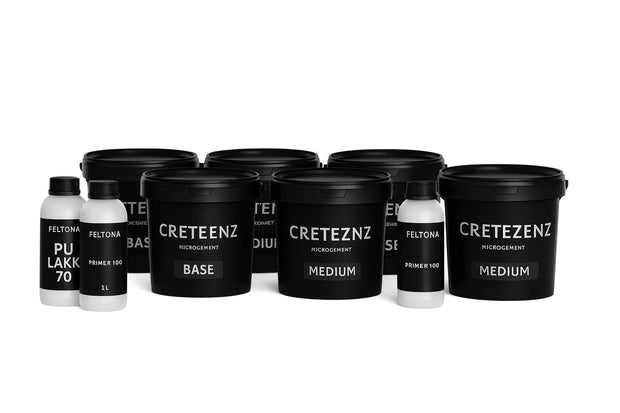
Feltona Cretezenz
Microcement offers a timeless and elegant design that suits most indoor surfaces-from bathrooms and kitchens to floors and stairs. The material is durable, virtually waterproof and seamless. Perfect for those who want to create a modern look with clean lines and lasting durability. Learn more about microcement.
fra 5 223 kr
Primer, two coats of Base, two coats of Medium, and two coats of PU varnish. Tools are sold separately. You can choose the color at no extra cost; enter the color code in the Order Instructions field in the shopping cart.


 Tilbud
24 m²
Dekker inntil 24,0 m² ved standard oppbygning
19 250 krFørpris 22 204 kr
På lager
Microcement is a thin, cement-based coating of around 3 mm applied directly to existing surfaces - floors, walls, bathrooms and stairs - and creates a single seamless surface without joints. Zenzorama specialises in microcement: we supply a complete system (Feltona Cretezenz with primer, base coat, top coat and PU varnish), hold courses in Oslo, and can do the work for you.
Original microcement is a mixture of Portland cement, sand and resins - with us, this is called Feltona Cretezenz. In addition, we have our own variants adapted for wet rooms, floors, walls, outdoor areas and facades. All share the seamless look: no tile joints, no grouting - just one continuous surface in the texture and colour you choose.
Read the full guide: what is microcement.

The same seamless look on most surfaces - with the right construction for each room.
Microcement is applied in thin layers, and the preparation determines the result. Here are the main steps:
Step 1
Remove silicone and loose parts, clean, and ensure the surface is firm, clean, and dry. In bathrooms, a waterproofing membrane is applied before the microcement.

890 kr
På lager
Bathrooms and wet rooms: Installed with a waterproofing membrane and the correct topcoat in accordance with wet room standards - professional installation recommended. Microcement in the bathroom
Step 2
Primer Z provides adhesion on walls. For floors, use Feltona Epoxy Primer DT (floors with up to 12% moisture), preferably with Quartz Primer on top for better friction when applying Base.

350 kr
På lager

849 kr
På lager

3 625 kr
På lager

7 125 kr
På lager
Step 3
Builds strength and smooths out joints and unevenness. Sand lightly between coats.

1 395 kr
På lager

2 388 kr
På lager
Standard consumption: 1.8 kg/m² Base (total for 2 coats). Calculate for your area
Step 4
Provides the final surface and color, with a fine or medium texture.

1 495 kr
På lager

2 628 kr
På lager

1 495 kr
På lager

2 628 kr
På lager
Fine: Top layer, smoothest finish. Medium: Top layer, more texture. Standard usage: 0.9 kg/m² Medium (total for 2 layers).
Step 5
The topcoat protects against water, stains, and wear.

990 kr
På lager

2 196 kr
På lager

3 160 kr
På lager
Standard coverage: 0.25 kg/m² of varnish (total for 2 coats).

790 kr
På lager

1 800 kr
På lager

1 800 kr
På lager

399 kr
På lager

499 kr
På lager
Many people apply microcement themselves. We recommend taking a course first.
 Tilbud
Fra 900 krFørpris 1 990 kr
Utsolgt
1 150 kr
Utsolgt
If you would like to sit back and leave the work to us, the price per square meter will be around:
This price includes both material costs and the execution of the work. The price range is due to the fact that the price per square meter varies depending on the surface the microcement is applied to.
If you want to do it yourself, you should budget between 650 and 900 kr/m², depending on size and substrate, in wet rooms with professional materials.
The standard build-up is 1 coat of primer, 2 coats of Cretezenz Base, 2 coats of Cretezenz Medium, and 2 coats of PU varnish. The quantities are calculated based on the standard consumption from the microcement calculator: 1.8 kg/m² Base and 0.9 kg/m² Medium (total for 2 coats), and 0.25 kg/m² varnish (total for 2 coats).
See microcement prices per square meter, or put together the material package with prices in the Package Selector.
Do you want to see all the steps with a video, materials list, and drying times? Read the complete guide: how to apply microcement. Would you rather have it done for you? Request a quote. You can find the full overview of systems and applications in our microcement guide.
Yes. In wet rooms, the surface is built up with a membrane and the correct topcoat in accordance with wet room standards (TEK17 where relevant). We recommend using a professional for the membrane application and wet room construction. Read more about requirements and construction under microcement in bathrooms.
Often not. Microcement is applied in a thin layer directly onto a solid, pre-treated substrate—in many cases, even over existing tiles. The substrate is assessed for each project.
Microcement provides a durable surface for everyday use. With the right topcoat, it withstands both wear and tear on floors and water in bathrooms.
Yes, many people apply microcement themselves. We recommend taking a course first and using the Package Selector to calculate quantities. If you are unsure, we will help you choose the right option.
It depends on the area, substrate, type of room, and whether you do the work yourself or want it professionally installed. See the price of microcement per square meter, or put together the material package with pricing in the Package Selector. Send us the project details, and we will provide a concrete recommendation.
All the colors we have, and we can create up to 3,500 different colors. See our color chart.

Cemher hos Zenzorama: 33 produkter for håndverkere, malere, entreprenører og arkitekter.
We assess the substrate and apply the microcement for you. Including materials and labor, the price per square meter is approximately 2,500–3,500 kroner for bathrooms and wet rooms, 2,000–3,000 kroner for floors, and 1,500–2,500 kroner for walls in dry rooms. The minimum price is 30,000 kr per job.
Advice from Rune Haraldsen on what you should know before choosing microcement, the colors you can choose from, and the course for those who want to do it themselves.
Why choose microcement, how to tell if the job is well or poorly done, and how much does microcement cost?
Farger
Feltona microcement can be mixed in over 3,500 unique colors according to the NCS color chart. Explore the color options for every room, and Rasmus Vold's terracotta bathroom.
Kurs
Microcement courses for private individuals and professionals at Zenzorama Academy in Oslo, Bergen, Trondheim and Stavanger. Course instructor Rune Haraldsen explains what sets successful participants apart, what you’ll learn and how to sign up.

