


Primers and preparation
The primers prepare the substrate for microcement. They provide adhesion, consolidate a weak substrate or block rising moisture, and sit at the bottom of the build-up, under the base coat.

5 products
Primer 100 is the standard bonding primer and is used under Cemher microcement on both absorbent and non-absorbent substrates. If the substrate is weak or dusty, it is first consolidated with Compactec. If there is moisture in the substrate, an epoxy primer that blocks the moisture is applied: Impripox at up to 5 % moisture, Aquasell at up to 7 %. Epoxy BV is the thick epoxy primer used as a moisture barrier and over tiles, with quartz sand, so the joints do not show through.
-
 Primer 100Bonding primer, 1-component water-based
Bonding primer in one coat under the microcement, on both absorbent substrates and smooth surfaces such as tiles.
Made to order
-
 CompactecConsolidating primer, 2-component epoxy
Consolidates a weak, dusty or porous substrate before primer, when the concrete or render is not strong enough.
Made to order
-
 AquasellWater-based epoxy primer against moisture
Water-based epoxy primer that blocks rising moisture, for substrates with up to 7 % moisture.
Made to order
-
 ImpripoxSolvent-based epoxy primer against moisture
Solvent-based epoxy primer that blocks moisture in absorbent substrates with up to 5 % moisture.
Made to order
-
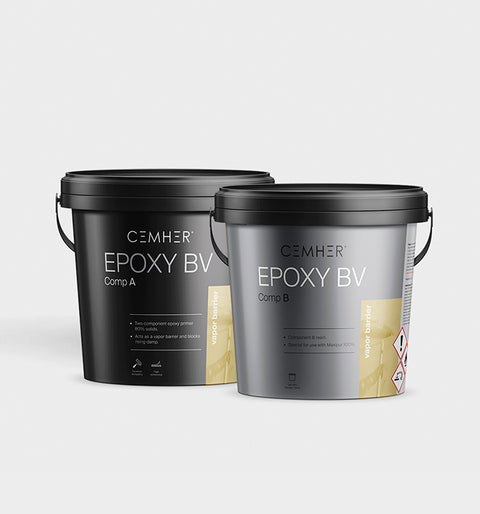 Epoxy BVThick epoxy primer and moisture barrier
Thick epoxy primer and moisture barrier, also over tiles with quartz sand so the joints do not show through.
Made to order


Which primer when
| Situation | Choose | Why |
|---|---|---|
| Firm, dry substrate: concrete, screed, render or gypsum | Primer 100 | Cemher uses Primer 100 in one coat on both absorbent and non-absorbent substrates, and it provides adhesion for the base coat. |
| Tiles and other non-porous surfaces such as marble and metal | Primer 100, after the joints have been filled and sanded | Primer 100 is a bonding primer that gives smooth, non-porous surfaces something to bond to. |
| Weak, crumbling or dusty substrate | Compactec, then Primer 100 | If the substrate does not hold 1.5 N/mm² in a pull-off test, Cemher requires it to be consolidated with Compactec before primer. |
| Some moisture in an absorbent substrate, up to 5 % measured 2 cm in | Impripox | The solvent-based epoxy penetrates and blocks the moisture, but Cemher sets the limit at 5 %. |
| More moisture in the substrate, up to 7 %, or rising damp | Aquasell | The water-based epoxy tolerates damper substrates and is what Cemher uses when the moisture is above the limit for Impripox. |
| Moisture barrier on a dry substrate, or before self-levelling screed | Epoxy BV | Cemher recommends an epoxy with 100 % solids as a moisture barrier where the substrate is not damp; if it is damp, Aquasell is applied first. |
| Tile joints that may show through the microcement | Epoxy BV with quartz sand | The thick epoxy layer with quartz sand broadcast into the wet coat builds over the joints and gives a rough surface for the next layer. |
Good to know
- The substrate must be firm, clean, dry and free of dust and grease before primer.
- In wet rooms, the microcement is applied on top of an approved waterproofing membrane, and it is the membrane that is the waterproof layer.
- The epoxy primers against moisture block moisture from the substrate, but they do not replace the membrane.
- The moisture limits are Cemher's own figures in percent, so measure the moisture in the substrate before you choose a primer, and contact us if in doubt.
- The build-up in wet rooms must follow the Norwegian wet-room standard (våtromsnormen), and we recommend a professional for the membrane work.